The History of Lyon Mountain, N. Y.
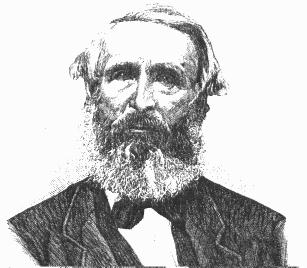
This is a portrait of Lewis Lyon, son of
Nathaniel
Lyon,
after whom the mountain and town were named.
..... This is a sketch of a small
little town
in the Adirondacks known as Lyon Mountain. When I was young, it was
said
that mountain lions had once roamed the mountain near Chazy Lake known
as
Lyon Mountain. As I grew older I learned that it was named after
Nathaniel Lyon, who settled in Saranac, Clinton co, NY, which is about
5-10 miles south
of the base of Lyon Mountain. His son (pictured above) Lewis Lyon was born 18 Sept 1814, in
Royalton,
VT. Nathaniel Lyon settled in Saranac in 1803 or 1804 and was one of
the
first settlers in that part of the county. He was a relative of Gen.
Nathaniel
Lyon, who was killed at the battle of Wilson's Creek, MO, in August
1861.
 New Books available..... "Lyon Mountain: The Tragedy of a Mining
Town"
New Books available..... "Lyon Mountain: The Tragedy of a Mining
Town"
You've done an
incredible
job with your site, and with spreading the word on North Country
history.
Many of the oldtimers that I've become friends with in Lyon Mountain
don't
have computers, so I have to tell them about it or print samples to
show
them. They are really proud of their heritage, so they love
hearing
that their hometown is known on the internet. We've been deeply
involved
in the village for some time now. Along with publishing our two
Lyon
Mountain books, we added a site dedicated to the village of Lyon
Mountain,
and so far it has raised well over $1000 in donations towards their
Mining
and Railroad Museum, which should be opening sometime in 2006.
We had previously
provided
a link to your site among our links on the Lyon Mountain pages, and if
you're
at all interested, we'd be pleased if you decided to add us to your
links.
Our main site is www.bloatedtoe.com.
My partner is in the process of adding Whitehall, N.Y. pages, and
possibly
increasing our Lyon Mountain pages.
We handled the publishing of
Whitehall's
history book, which is officially being launched on November 10, and we
are beginning to offer our publishing services to others via a unique
partnering arrangement.
Thanks,
Larry Gooley
<goolyman@charter.net>
<>Go to
History of the Chateaugay Ore and Iron Company
Go to Page 2 of The History of Lyon
Mountain.
Go to Bulletin Board for Lyon Mountain.
Go to Page 3 of The History of Lyon
Mountain.
Go to Lyon Mountain: The
Town
that refused to die. Lots of pictures
Go to Mining History for The History of
Mining
in the North Country.
Go to Page 5 of The History of Lyon
Mountain. (for
article on Lyon Mt. and Mineville)
Levi White of Clintonville has provided an
oral
history of his life including his years working in the mines of Lyon
Mt.
He also provided sketches from memory of the operation at the Lyon Mt.
mine
ca 1940. The sketches were produced in Jan 1992 with the assistance of
Gordon
Pollard, Professor of Anthropology, PSUC. Thanks to The Feinberg
Library
Special Collections for this valuable history. See: Lyon Mt. Sketch page 1 for this
information.
In 1999, I completed more articles concerning Lyon
Mountain and nearby areas. One article deals with an Oral History of Levi White, who worked in
the
mines and other northcountry places I know. He made sketches of
the
mine operation as it was in 1940. Look to those links for the latest
info
I've compiled from articles and personal tours of present state of Lyon
Mt.
and mines.Also in 1999, I started posting articles from a publication
called
"Mining for Souls". Find these articles on Souls 1, and St. Bernard's 1...................................ROD
11/18/99.
Our Town
The hamlet of Lyon Mountain, located in the
scenic Adirondacks, is a rural, insular community. The residents are
self-sufficient, as there is no local government. The community was
founded around 1868 and,
until 1967, was a company owned community, which profoundly affected
the
people and their initiative. The community is in the process of
emerging from
this protective custody and realizing that any change for the future is
up
to them. This takes time and is a difficult process.
There are many wonderful ethnic attitudes
still
prevelant in the French, Italian and Polish hamlet. A tragedy brings
people
together and a covered dish meal at the American Legion brings out a
real
smorgasbord. This is a community tied to its past, but also looking
forward
to the future and what must be done to make that future a success.
It is with these wonderful memories of all
that
has been that this brief history is written to chronical our town and
its
beginnings. This is a contribution to the bicentennial year of Clinton
County,
and to all the people, past and present, of the Hamlet of Lyon
Mountain........Helena
T. Penalis June, 1988
The Hamlet of Lyon Mountain
The "Hamlets of the Adirondacks" describes
Lyon Mountain as the "the perfect example of an industry-deserted
mining town. Workers' housing and neglected mines present
dramactic images in a community where people are experiencing fewer
services on a minimal economic base."
The "Economic Development in Northern New
York"
report states: "Frequent reference is made to what is viewed as a North
Country
syndrome.....negative attitude.' 'There is a severe shortage of
cultural
resources as well as recreational facilities." There is a lack of
diversity
in the life of the North Country."
This may be the image presented to the
statistician
compiling flgures for surveys but it is not what is seen by senior
residents
who remember when things were different. They see the hamlet as a small
spot
of scenic delight in the foothills of the Adirondacks with clean air
and
spring water. They also remember when it was home to one of the largest
employers
in the county and had a population of approximately 4,000 residents.
Let's
go back in time and take a fast trip forward through the history of
Lyon
Mountain.
The Beginning
The first known record of the town (or its
future site) is in 1823 when ore, practically phosphorus-free, was
discovered by
a trapper named George Collins. Nothing more was done until 1868 when
Messrs.Foote,
Weed, Meade and Waldo made a contract with Mr. Edmund Rogers, who owned
the
tract of land, to purchase four-fifths of his property. Much litigation
followed
between the four gentlemen and Mr. Rogers and others and continued
until
a Mr. Williams and Mr. Weed became sole owners of the property. These
two
gentlemen formed a partnership which became known as the Chateaugay Ore
and
Iron Companies and, in the fall of 1873, the work of developing the
land
began in earnest.
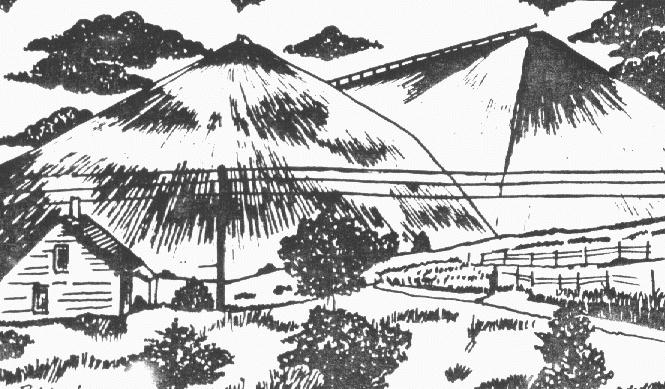 Log Cabin against Sand Piles
At this time there was only a small clearing
in
the dense forest, with a few log shanties in the area now known as Mine
Street
and West Mine Street. The area needed a name, so it was named Lyon
Mountain
after the resident in the area--Nathaniel Lyon--who came here in the
winter
of 1803 from Vermont and settled at the base of Lyon Mountain. He
cleared
a large farm in the area and lived there until he died around 1850. The
St.
Bernard's Church records state that the hamlet was first named
Rogersfield
after Edmund Rogers but, sometime in the l880's it was renamed Lyon
Mountain.
In the following year, as the property
expanded, more and more miners were brought in, until number reached
one hundred and
fifty. This meant that new houses had to be built, as there were only
40
houses, a small wooden church and a school.
Community Services
In 1879 a post office was established in Lyon
Mountain
as part of the general store. Now the little community was officially
on
the map. A splendid two-story store was built, having a basement and
first
floor for groceries and office. An upper floor held an assortment of
dry and fancy goods and fashion apparel, along with an
apartment for the manager (Mr. J. Obrist).
A railroad was needed to develop
the rich resources
of this property. In May 1879 the Chateaugay Railroad
Company
was organized and, on December 1879, the first regular train ran over
the
entire line and the first train of ore was shipped to Plattsburgh.
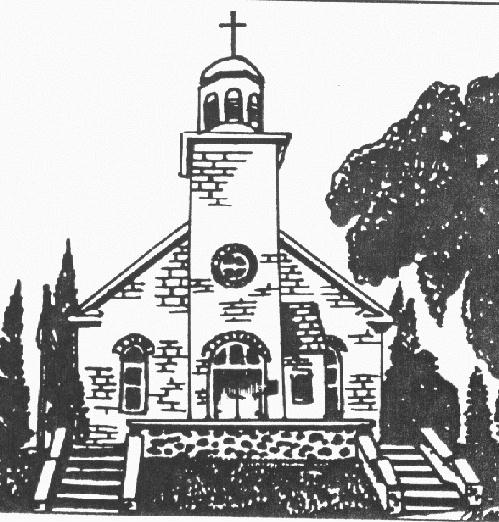
St Bernard's Church
By 1883 Lyon Mountain had grown from a few
shacks in the wilderness to a thriving community of over 300 miners and
700 residents, the busiest spot in Clinton County. During the 1880's
the first Catholic Church
of St. Bernard's was built, along with a rectory and barn to stable the
horses
of the parishioners during Mass. In 1901 the wooden church burned to
the
ground and the present church was built. There have been many
renovations to the interiors and exteriors, but both the church and
rectory have remained intact.
At this time the first Methodist Church was built in the
community
on Depot Hill. This was on land deeded to the church by the Rogers
family.
The church remained at that location until 1952 when the present
Memorial
Methodist Church was built.
Religion was a dominant force in this ethnic community with much of the
social
life centering around church suppers and church bazaars. The community
was
approximately 90 percent Catholic and 10 percent Methodist, which
continues
today. Yet, the cooperation and ecumenism that has always prevailed
between
these two groups could be a model for world unity. Although, the years
have
brought the inevitable changes in social life, the community remains
respectful
of religion.
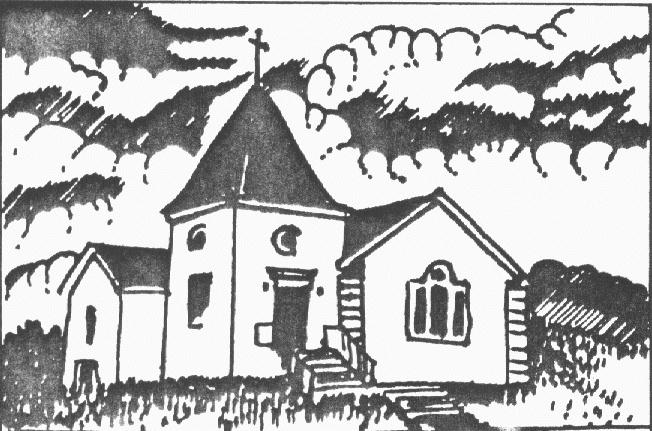
Memorial Methodist Church
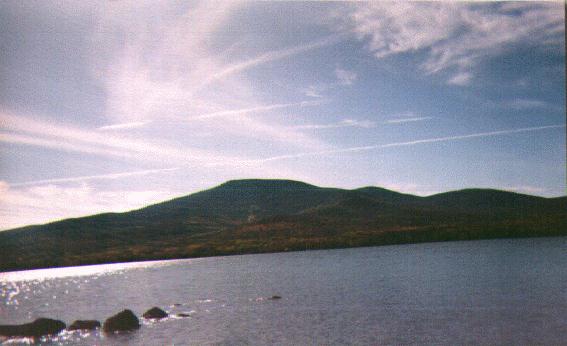
This is a view of Lyon Mountain taken from the east shore of Chazy
Lake. It is said that the mine shafts of the old Republic Steel Co. ran
under the
mountain and even Chazy Lake. In the 50's you could hear the blasting
in
the mine and it appeared to be very close.
This narrative continues on Page 2
of
The History of Lyon Mountain.
Sources:
Adirondack Museum photos, Blue Mountain Lake, NY;
Hurd; History of Clinton County, New York;
Rod Bigelow (Roger Jon12
BIGELOW)
Box 13 Chazy Lake
Dannemora, NY 12929
 rodbigelow@netzero.net
BACK TO THE HISTORY PAGE

BACK TO BIGELOW
HOME
PAGE