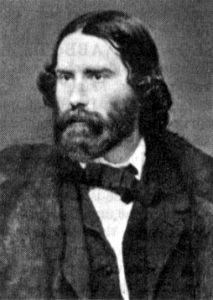
Katharine Bigelow 7 LAWRENCE
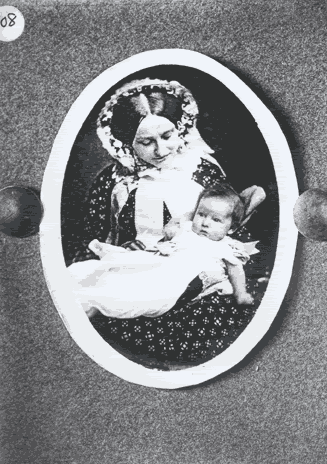
Katherine and son Percival (about August 1855)
16952.17 Katharine Bigelow 7
LAWRENCE, dau of Katharine 6
( Timothy 5 , Timothy 4 ,Daniel
3,Joshua2, John1) BIGELOW, and Hon.
Abbott LAWRENCE, was born 21 February 1832. She married 01
June 1854 Augustus Lowell, son of John Amory Lowell of
Boston. They had three sons
and four daughters, of whom five reached maturity. Best-known among
them
were:
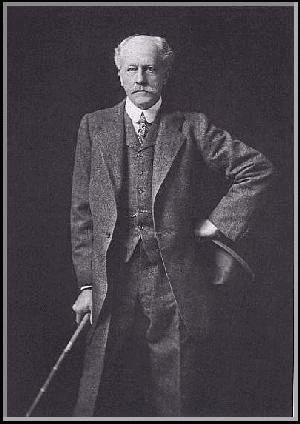
16952.17a Percival,
b 13 Mar 1855; d 13 Nov 1916; m Constance Savage Keith; he was a
prominent astronomer and founder of Lowell Observatory.
Lowell,
Percival (1855-1916), American astronomer, who made
significant observations of the planets. He is best known for his
belief that there are canals on the surface of Mars and that these
canals provide evidence for the existence of intelligent life there.
Born in Boston, Massachusetts, and educated at Harvard University,
Lowell traveled in Japan and Korea from 1877 until 1893 and later wrote
books about East Asia. In 1894 he founded and became director of the Lowell Observatory at Flagstaff,
Arizona. From 1902 until his death, he was nonresident professor of
astronomy at the Massachusetts Institute of Technology. He predicted
the discovery of Pluto, which astronomers first observed in 1930 at the
Lowell Observatory. Lowell's writings include Mars and Its Canals
(1906), Memoir on a Trans-Neptunian Planet (1915), and The Genesis of
the Planets (1916). Visit link for more
information, including:
The American astronomer Percival Lowell, b.
Boston, Mar. 13, 1855, d. Nov. 12, 1916, is best known for his belief
in the existence of artificial canals on MARS. Lowell was a businessman
and traveler in the Far East before becoming obsessed with Giovanni
Schiaparelli's report (1877) of canali ("channels") on Mars. He founded
(1894) the Lowell Observatory near Flagstaff, Ariz., especially for
studying the Martian
surface, and for more than a decade he charted the apparently
crisscross
markings of Mars.
Although
other astronomers vehemently denied the existence of canals on Mars,
Lowell maintained that not only did they exist, they had also been
built by intelligent beings. Not until the Mars probes of the 1960s
were Lowell's claims conclusively disproved. Despite the controversy
over the Martian canals, Lowell Observatory has contributed
substantially to studies of the planets and the stars.
Lowell himself predicted the position of a perturbing planet beyond
Neptune,
later discovered by Clyde Tombaugh, (b. Feb. 4, 1906 d. Jan. 17,1997)
and
named Pluto.
See more of Percival at the following LINK:
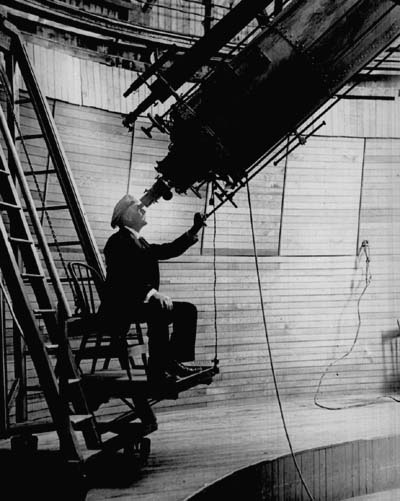
Percival Lowell (1855-1916) is one of the best known
observers of
the planet Mars. Lowell is pictured here in the observer's chair of the
61-centimeter
(24-inch) refracting telescope in the observatory he established in
Flagstaff,
Arizona. Lowell Observatory is still one of the foremost sites for
telescopic
studies of Mars and the other planets.
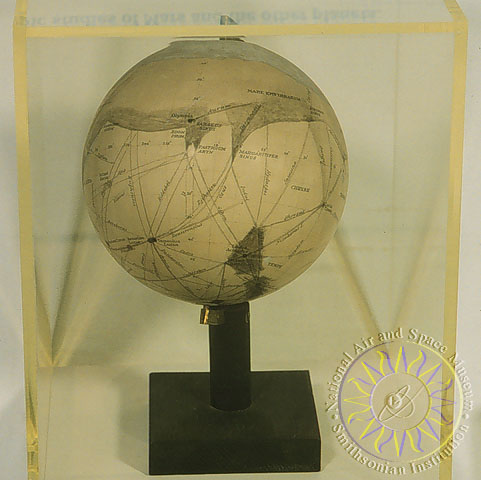
Percival Lowell made this globe of Mars summarizing his observations of
the planet for the year 1901.
The straight lines represent features that were first "seen" by the
Italian astronomer Giovanni Schiaparelli in 1877.
He called them canali, an Italian word meaning channels.
The canali were also observed by Lowell who concluded they were canals
built by intelligent beings.
The canals supposedly supplied water from the melting polar caps to a
desert world.
In his book "Mars as the Abode of Life", published in 1908, Percival
Lowell presented his theory that Mars' canals were built by intelligent
beings.
Today we know that there are no canals built by intelligent beings on
Mars and that Lowell was mistaken in his conclusions.
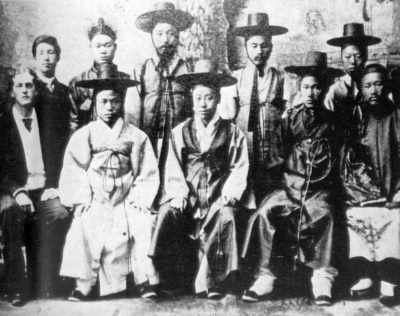
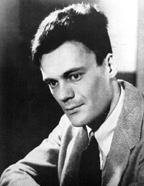
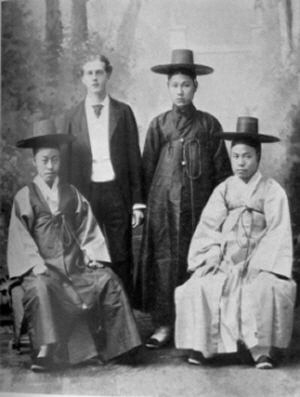 (above) A young Percival Lowell in Korea (ca 1883)
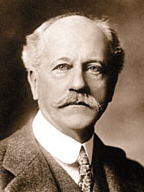 Percival
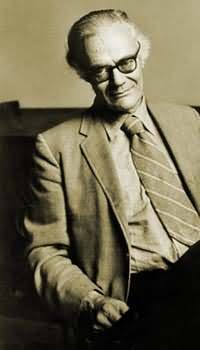
16952.17b. Abbott Lawrence Lowell,
was born 13 December 1856. He married in 1879 Anna Parker Lowell;
no issue. He was of M.I.T. and Lowell Institute, wrote with scholarship
on many subjects, was president of Harvard College 1909-1933, and known
for his educational reforms. He died 06 January 1943.
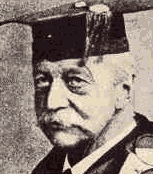
Lowell, Abbott Lawrence (1856-1943), American educator, born in
Boston, and educated at Harvard University and Harvard Law School. He
practiced law in Boston from 1880 to 1897, when he became a lecturer in
political
science at Harvard. He was appointed professor in 1900 and nine years
later
became president of the university. Among the administrative reforms he
introduced were general examinations given in their major subject to
candidates
for the baccalaureate degrees, the institution of the tutoring system
for
upperclassmen, and the establishment of a house plan, comprising
residential
units similar to those in British universities. In 1927 Lowell was
appointed
by Massachusetts Governor Alvin Tufts Fuller as a member of a committee
to advise the governor with regard to the Sacco-Vanzetti case. The
opinion
rendered by this committee was that the defendants had had a fair trial
and had been justly convicted. Lowell retired from the presidency of
Harvard
in 1933. He was a strong supporter of American participation in the
League
of Nations. His writings include Essays on Government (1889), Conflicts
of Principle (1932), and What a University President Has Learned (1938).
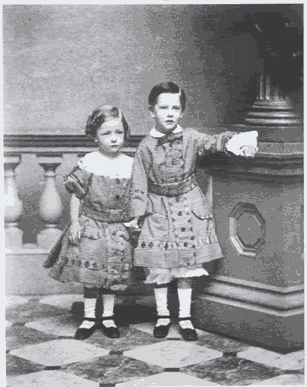
Percival and A. Lawrence Lowell
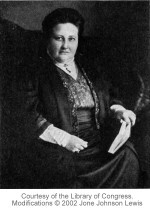
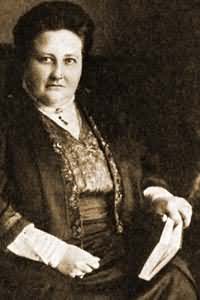
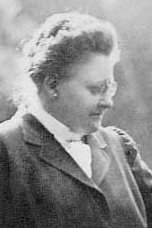
16952.17c. Amy Lawrence Lowell, was
born 09 February 1874 (the seventh child). She died 01 May 1925;
unmarried; educated Baylor, Columbia, and Tufts; in literature at Brown
and Yale;
well-known American poet.
Biography
Amy Lowell About the author:
From the notes to "The Second Book of Modern Verse" (1919, 1920),
edited by Jessie B. Rittenhouse.
Lowell, Amy. Born in Brookline, Mass., Feb. 9, 1874. Educated at
private schools. Author of "A Dome of Many-Coloured Glass", 1912;
"Sword Blades and Poppy Seed", 1914; "Men, Women and Ghosts", 1916;
"Can Grande's Castle", 1918; "Pictures of the Floating World", 1919.
Editor of the three successive collections of "Some Imagist Poets",
1915, '16, and '17, containing the early work of the "Imagist School"
of which Miss Lowell became the leader. This movement, . . . originated
in England, the idea have been first conceived by a young poet named T.
E. Hulme, but developed and put forth by Ezra Pound in an article
called "Don'ts by an Imagist", which appeared in 'Poetry; A Magazine of
Verse'. . . . A small group of poets gathered about Mr. Pound,
experimenting along the technical lines suggested, and a cult of
"Imagism" was formed, whose first group-expression was in the little
volume, "Des Imagistes", published in New York in April, 1914. Miss
Lowell did not come actively into the movement until after that time,
but once she had entered it, she became its leader, and it was chiefly
through her effort in America that the movement attained so much
prominence and so influenced the trend of poetry for the years
immediately succeeding. Miss Lowell many times, in
admirable articles, stated the principles upon which Imagism is based,
notably
in the Preface to "Some Imagist Poets" and in the Preface to the second
series, in 1916. She also elaborated it much more fully in her volume,
"Tendencies
in Modern American Poetry", 1917, in the articles pertaining to the
work
of "H.D." and John Gould Fletcher. In her own creative work, however,
Miss
Lowell did most to establish the possibilities of the Imagistic idea
and
of its modes of presentation, and opened up many interesting avenues of
poetic
form. Her volume, "Can Grande's Castle", is devoted to work in the
medium
which she styled "Polyphonic Prose" and contains some of her finest
work,
particularly "The Bronze Horses".
Lowell, Amy Lawrence (1874-1925), American poet and critic, one of the
leaders of the imagist school (see Imagism). She was born in Brookline,
Massachusetts, and was the sister of astronomer Percival Lowell and
Harvard University President Abbott Lawrence Lowell. She traveled
widely, lectured on poetry, and edited three imagist anthologies. As an
imagist she championed free verse, tight precision in vocabulary, and
concise style. Her volumes of verse include Sword Blades and Poppy
Seeds (1914); Men, Women, and Ghosts (1916), which contains her
well-known poem "Patterns"; Pictures of the Floating World (1919);
What's O'Clock (1925), which won the Pulitzer Prize in 1926; and
Ballads for Sale (1927). Among her critical works are Tendencies in
Modern American Poetry (1917) and the biography John Keats
(1925).
Amy Lowell didn't become a poet until she was years into her
adulthood; then, when she died early, her poetry (and life) were nearly
forgotten -- until gender studies as a discipline began to look at
women like Lowell as illustrative of an earlier lesbianism. She
lived her later years in a "Boston marriage" and wrote erotic love
poems addressed to a woman.
T. S. Eliot called her the "demon saleswoman of poetry." Of
herself, she said, "God made me a businesswoman and I made myself a
poet."
Amy Lowell was born to wealth and prominence. Her paternal grandfather,
John Amory Lowell, developed the cotton industry of Massachusetts with
her maternal grandfather, Abbott Lawrence. The towns of Lowell
and
Lawrence, Massachusetts, are named for the families. John Amory
Lowell's
cousin was the poet James Russell Lowell.
Amy was the youngest child of five. Her eldest brother, Percival
Lowell, became an astronomer in his late 30s and founded Lowell
Observatory in Flagstaff, Arizona. He discovered the "canals" of
Mars. Earlier he'd written two books inspired by his travels to
Japan and the Far East. Amy Lowell's other brother, Abbott Lawrence
Lowell, became president of Harvard University.
The family home was called "Sevenels" for the "Seven L's" or Lowells.
Amy Lawrence was educated there by an English governess until 1883,
when she was sent to a series of private schools. She was far
from a model student. During vacations, she traveled with her family to
Europe and
to America's west.
In 1891, as a proper young lady from a wealthy family, she had her
debut. She was invited to numerous parties, but did not get the
marriage proposal that the year was supposed to produce. A university
education was out of the question for a Lowell daughter, although not
for the sons. So Amy Lowell set about educating herself, reading
from the 7,000 volume library of her father and also taking advantage
of the Boston Athenaeum.
Mostly she lived the life of a wealthy socialite. She began a lifelong
habit of book collecting. She accepted a marriage proposal, but the
young man changed his mind and set his heart on another woman.
Amy Lowell went to Europe and Egypt in 1897-98 to recover, living on a
severe diet that was supposed to improve her health (and help with her
increasing weight problem). Instead, the diet nearly ruined her health.
In 1900, after her parents had both died, she bought the family home,
Sevenels. Her life as a socialite continued, with parties and
entertaining. She also took up the civic involvement of her father,
especially in supporting education and libraries.
Amy had enjoyed writing, but her efforts at writing plays didn't meet
with her own satisfaction. She was fascinated by the theater. In
1893 and 1896, she had seen performances by the actress Eleanora
Duse. In 1902, after seeing Duse on another tour, Amy went home
and wrote a tribute to her in blank verse -- and, as she later said, "I
found out where my
true function lay." She became a poet -- or, as she also later
said,
"made myself a poet."
By 1910, her first poem was published in Atlantic Monthly, and three
others were accepted there for publication. In 1912 -- a year that also
saw the first books published by Robert Frost and Edna St. Vincent
Millay -- she published her first collection of poetry, A Dome of
Many-Coloured Glass.
It was also in 1912 that Amy Lowell met actress Ada Dwyer
Russell. From about 1914 on, Russell, a widow who was 11 years
older than Lowell, became Amy's traveling and living companion and
secretary. They lived together in a "Boston marriage" until Amy's
death. Whether the relationship was platonic or sexual is not
certain -- Ada burned all personal correspondence as executrix for Amy
after her death -- but poems which Amy clearly directed towards Ada are
sometimes erotic and full of suggestive imagery.
In the January 1913 issue of Poetry, Amy read a poem signed by "H.D.,
Imagiste." With a sense of recognition, she decided that she,
too, was an Imagist, and by summer had gone to London to meet Ezra
Pound and other Imagist poets, armed with a letter of introduction from
Poetry editor Harriet Monroe.
She returned to England again the next summer -- this time bringing her
maroon auto and maroon-coated chauffeur, part of her eccentric
persona. She returned to America just as World War I began,
having sent that maroon auto on ahead of her.
She was already by that time feuding with Pound, who termed her version
of Imagism "Amygism." She focused herself on writing poetry in
the new style, and also on promoting and sometimes literally supporting
other poets who were also part of the Imagist movement.
In 1914, she published her second book of poetry, Sword Blades and
Poppy Seeds. Many of the poems were in vers libre (free verse), which
she
renamed "unrhymed cadence." A few were in a form she invented, which
she
called "polyphonic prose."
In 1915, Amy Lowell published an anthology of Imagist verse, followed
by new volumes in 1916 and 1917. Her own lecture tours began in
1915, as she talked of poetry and also read her own works. She
was
a popular speaker, often speaking to overflow crowds. Perhaps the
novelty of the Imagist poetry drew people; perhaps they were drawn to
the
performances in part because she was a Lowell; in part her reputation
for
eccentricities helped bring in the people.
She slept until three in the afternoon and worked through the
night. She was overweight, and a glandular condition was
diagnosed which caused her to continue to gain. (Ezra Pound called her
"hippopoetess.") She was operated on several times for persistent
hernia problems.
She dressed mannishly, in severe suits and men's shirts. She wore
a pince nez and had her hair done -- usually by Ada Russell -- in a
pompadour that added a bit of height to her five feet. She slept on a
custom-made bed with exactly sixteen pillows. She kept sheepdogs
-- at least
until World War I's meat rationing made her give them up -- and had to
give guests towels to put in their laps to protect them from the dogs'
affectionate habits. She draped mirrors and stopped clocks. And,
perhaps most famously, she smoked cigars -- not "big, black" ones as
was
sometimes reported, but small cigars, which she claimed were less
distracting
to her work than cigarettes, because they lasted longer.
In 1915, she also ventured into criticism with Six French Poets,
featuring Symbolist poets little known in America. In 1916, she
published another volume of her own verse, Men, Women and Ghosts. A
book derived from her lectures, Tendencies in Modern American Poetry
followed in 1917, then another poetry collection in 1918, Can Grande's
Castle and Pictures of the Floating World in 1919 and adaptations of
myths and legends in 1921 in Legends.
During an illness in 1922 she wrote and published A Critical Fable --
anonymously. For some months she denied that she'd written it. Her
relative, James Russell Lowell, had published in his generation A Fable
for Critics, witty and pointed verse analyzing poets who were his
contemporaries. Amy Lowell's A Critical Fable likewise skewered
her own poetic contemporaries.
She worked for the next few years on a massive biography of John Keats,
whose works she'd been collecting since 1905. Almost a day-by-day
account of his life, the book also recognized Fanny Brawne for the
first time as a positive influence on him.
This work was taxing on Lowell's health, though. She nearly ruined her
eyesight, and her hernias continued to cause her trouble. In May
of 1925, she was advised to remain in bed with a troublesome hernia. On
May 12 she got out of bed anyway, and was struck with a massive
cerebral hemorrhage. She died hours later.
Ada Russell, her executrix, not only burned all personal
correspondence, as directed by Amy Lowell, but also published three
more volumes of Lowell's poems posthumously. These included some
late sonnets to Eleanora Duse, who had died in 1912 herself, and other
poems considered too controversial for Lowell to publish during her
lifetime. Lowell left her fortune and Sevenels in trust to Ada Russell.
The Imagist movement didn't outlive Amy Lowell for long. Her poems
didn't withstand the test of time well, and while a few of her poems
("Patterns" and "Lilacs" especially) were still studied and
anthologized, she was nearly forgotten.
Then, Lillian Faderman and others rediscovered Amy Lowell as an example
of poets and others whose same-sex relationships had been important to
them in their lives, but who had -- for obvious social reasons -- not
been
explicit and open about those relationships. Faderman and others
re-examined
poems like "Clear, With Light Variable Winds" or "Venus Transiens" or
"Taxi" or "A Lady" and found the theme -- barely concealed -- of the
love of women. "A Decade," which had been written as a
celebration of the ten year anniversary of Ada and Amy's relationship,
and the "Two Speak Together" section of
Pictures of the Floating World was recognized for the love poetry that
it is.
The theme was not completely concealed, of course, especially to those
who knew the couple well. John Livingston Lowes, a friend of Amy
Lowell's, had recognized Ada as the object of one of her poems, and
Lowell wrote back to him, "I am very glad indeed that you liked
'Madonna of the Evening Flowers.' How could so exact a portrait remain
unrecognized?"
And so, too, the portrait of the committed relationship and love of Amy
Lowell and Ada Dwyer Russell was largely unrecognized until recently.
Her "Sisters" -- alluding to the sisterhood that included Lowell,
Elizabeth Barrett Browning and Emily Dickinson -- makes it clear that
Amy Lowell saw herself as part of a continuing tradition of women poets.
Lowell, Robert Traill Spence, Jr. (1917-1977), American poet,
noted for his lyric virtuosity, rich language, and social concern. A
cousin of the distinguished intellectuals Amy Lowell, Percival Lowell,
and Abbott Lowell, Robert Lowell was born in Boston, Massachusetts,
and
educated at Harvard University and Kenyon College. Lowell suffered
religious doubt and temporarily converted to Roman Catholicism in 1940;
later he was imprisoned briefly for refusing to serve in World War II
(1939-1945). During the 1950s he spent time in a mental hospital, and
in the 1960s he took part in the antiwar and civil rights movements.
More Biography:
Robert Lowell was born in 1917 into one of Boston's
oldest and most prominent families. He attended Harvard College for two
years before transferring to Kenyon College, where he studied poetry
under John Crowe Ransom and received an undergraduate degree in 1940.
He took
graduate courses at Louisiana State University where he studied with
Robert
Penn Warren and Cleanth Brooks. His first and second books, Land of
Unlikeness (1944) and Lord Weary's Castle (for which he received a
Pulitzer Prize
in 1946, at the age of thirty), were influenced by his conversion from
Episcopalianism to Catholicism and explored the dark side of America's
Puritan legacy.
Under the influence of Allen Tate and the New Critics, he wrote
rigorously
formal poetry that drew praise for its exceptionally powerful handling
of meter and rhyme. Lowell was politically involved—he became a
conscientious
objector during the Second World War and was imprisoned as a result,
and
actively protested against the war in Vietnam—and his personal life was
full of marital and psychological turmoil. He suffered from severe
episodes
of manic depression, for which he was repeatedly hospitalized.
Partly in response to his frequent breakdowns, and
partly due to the influence of such younger poets as W. D. Snodgrass
and Allen Ginsberg, Lowell in the mid-fifties began to write more
directly from personal experience, and loosened his adherence to
traditional meter and form. The result was a watershed collection, Life
Studies (1959), which forever changed the landscape of modern poetry,
much as Eliot's The Waste Land had three decades before. Considered by
many to be the most important poet in English of the second half of the
twentieth century, Lowell continued to develop his work with sometimes
uneven results, all along defining the restless center of American
poetry, until his sudden death from a heart attack at age 60. Robert
Lowell served as a Chancellor of The Academy of American
Poets from 1962 until his death in 1977.
Lowell's first volume of poems, Land of Unlikeness (1944), reflected
the disturbing effects of World War II. The volume Lord Weary's Castle
(1946; Pulitzer Prize, 1947) contains his highly acclaimed poem
"Colloquy at Black Rock," which centers on a Roman Catholic feast. The
chief long narrative poem in Mills of the Kavanaughs (1951) is a Greek
legend set in New England. Life Studies (1959), which received the
National Book Award in 1960, revealed Lowell's inner torments and
marked him as an influential figure in the emergence of confessional
poetry in the 1950s (see American Literature: 20th-Century Poetry).
Later poems in For the Union Dead (1964) and Near the Ocean (1967) are
more political. His other works of poetry include
Imitations (1961) and The Dolphin (1973; Pulitzer Prize, 1974). Lowell
had
a remarkable ability to express in his poetry both objective and
subjective
views of the turmoil of the contemporary world. His trilogy of plays,
The
Old Glory (1965), is a historical survey of American culture. He also
adapted
the ancient Greek dramas Phaedra (1963) and Prometheus Bound (1969).
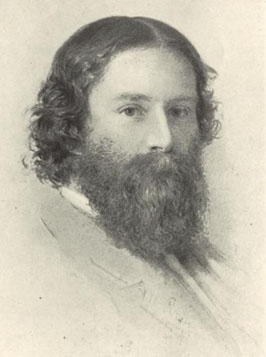
James Russell Lowell, was born
22 February 1819; died 12 August 1891;
American author and diplomat, one of the famous men
of his time but fame and reputation now diminished, was born at Elmwood
in Cambridge, Massachusetts, on the 22nd of February 1819. He was the
son of Charles Lowell, a Unitarian pastor in Boston. On his
mother's
side he was descended from the Spences and Traills, who made their home
in the Orkney Islands, his great-grandfather, Robert Traill, returning
to
England on the breaking out of hostilities in 1775. He was brought up
in
a neighborhood bordering on the open country, and from his earliest
years
he found a companion in nature; he was also early initiated into the
reading
of poetry and romance, hearing Edmund Spenser and Sir Walter Scott in
childhood,
and introduced to old ballads by his mother. He had for schoolmaster an
Englishman
who held by the traditions of English schools, so that before he
entered
Harvard College he had a more familiar acquaintance with Latin verse
than
most of his fellows -- a familiarity which showed itself later in his
mock-pedantic accompaniment to The
Biglow Papers and his macaronic poetry. He was a wide reader,
but a somewhat indifferent student, graduating at Harvard without
special honors in 1838. During his college course he wrote a number of
trivial pieces for a college magazine, and shortly after graduating
printed for private circulation the poem which his class asked him to
write for their graduation festivities.
He was uncertain at first what vocation to choose,
and vacillated between business, the ministry, medicine and law. He
decided at last to practice law, and after a course at the Harvard law
school, was admitted to the bar. While studying for his profession,
however, he contributed poems and prose articles to various magazines.
He cared little for the law, regarding it simply as a distasteful means
of livelihood, yet
his experiments in writing did not encourage him to trust to this for
support.
An unhappy adventure in love deepened his sense of failure, but he
became
betrothed to Maria White in the autumn of 1840, and the next twelve
years
of his life were deeply affected by her influence. She was a poet of
delicate
power, but also possessed a lofty enthusiasm, a high conception of
purity
and justice, and a practical temper which led her to concern herself in
the movements directed against the evils of intemperance and slavery.
Lowell
was already looked upon by his companions as a man marked by wit and
poetic
sentiment; Miss White was admired for her beauty, her character and her
intellectual gifts, and the two became thus the hero and heroine among
a
group of ardent young men and women. The first fruits of this passion
was
a volume of poems, published in 1841, entitled A Year's Life, which was
inscribed by Lowell in a veiled dedication to his future wife, and was
a
record of his new emotions with a backward glance at the preceding
period
of depression and irresolution. The betrothal, moreover, stimulated
Lowell
to new efforts towards self-support, and though nominally maintaining
his
law office, he threw his energy into the establishment, in company with
a friend, Robert Carter, of a literary journal, to which the young men
gave
the name of The Pioneer. It was to open the way to new ideals in
literature
and art, and the writers to whom Lowell turned for assistance --
Hawthorne,
Emerson, Whittier, Poe, Story and Parsons, none of them yet possessed
of
a wide reputation -- indicate the acumen of the editor. Lowell himself
had
already turned his studies in dramatic and early poetic literature to
account
in another magazine, and continued the series in The Pioneer, besides
contributing
poems; but after the issue of three monthly numbers, beginning in
January
1843, the magazine came to an end, partly because of a sudden disaster
which
befell Lowell's eyes, partly through the inexperience of the conductors
and unfortunate business connections.
The venture confirmed Lowell in his bent towards literature. At the
close of 1843 he published a collection of his poems, and a year later
he gathered up certain material which he had printed, sifted and added
to it, and produced Conversations on some of the Old Poets. The
dialogue
form was used merely to secure an undress manner of approach to his
subject; there was no attempt at the dramatic. The book reflects
curiously Lowell's mind at this time, for the conversations relate only
partly to the poets and dramatists of the Elizabethan period; a slight
suggestion sends the
interlocutors off on the discussion of current reforms in church and
state
and society. Literature and reform were dividing the author's mind, and
continued to do so for the next decade. Just as this book appeared
Lowell
and Miss White were married, and spent the winter and early spring of
1845
in Philadelphia. Here, besides continuing his literary contributions to
magazines, Lowell had a regular engagement as an editorial writer on
The
Pennsylvania Freeman, a fortnightly journal devoted to the Anti-Slavery
cause.
In the spring of 1845 the Lowells returned to Cambridge and made their
home
at Elmwood. On the last day of the year their first child, Blanche, was
born,
but she lived only fifteen months. A second daughter, Mabel, was born
six
months after Blanche's death, and lived to survive her father; a third,
Rose,
died an infant. Lowell's mother meanwhile was living, sometimes at
home,
sometimes at a neighboring hospital, with clouded mind, and his wife
was
in frail health. These troubles and a narrow income conspired to make
Lowell
almost a recluse in these days, but from the retirement of Elmwood he
sent
forth writings which show how large an interest he took in affairs. He
contributed
poems to the daily press, called out by the Slavery question; he was,
early
in 1846, a correspondent of the London Daily News, and in the spring of
1848 he formed a connection with the National Anti-Slavery Standard of
New York, by which he agreed to furnish weekly either a poem or a prose
article. The poems were most frequently works of art, occasionally they
were tracts;
but the prose was almost exclusively concerned with the public men and
questions of the day, and forms a series of incisive, witty and
sometimes
prophetic diatribes. It was a period with him of great mental activity,
and is represented by four of his books which stand as admirable
witnesses
to the Lowell of 1848, namely, the second series of Poems, containing
among others "Columbus", "An Indian Summer Reverie", "To the
Dandelion",
"The Changeling"; A Fable for Critics, in which, after the manner of
Leigh
Hunt's The Feast of the Poets, he characterizes in witty verse and with
good-natured satire American contemporary writers, and in which, the
publication
being anonymous, he included himself; The Vision of Sir Launfal, a
romantic
story suggested by the Arthurian legends -- one of his most popular
poems;
and finally The Biglow Papers.
Lowell had acquired a reputation among men of letters and a cultivated
class of readers, but this satire at once brought him a wider fame. The
book was not premeditated; a single poem, called out by the recruiting
for the abhorred Mexican war, couched in rustic phrase and sent to the
Boston Courier, had the inspiriting dash and electrifying rat-tat-tat
of this
new recruiting sergeant in the little army of Anti-Slavery reformers.
Lowell
himself discovered what he had done at the same time that the public
did,
and he followed the poem with eight others either in the Courier or the
Anti-Slavery Standard. He developed four well-defined characters in the
process -- a
country farmer, Ezekiel Biglow, and his son Hosea; the Rev. Homer
Wilbur,
a shrewd old-fashioned country minister; and Birdofredum Sawin, a
Northern
renegade who enters the army, together with one or two subordinate
characters;
and his stinging satire and sly humour are so set forth in the
vernacular
of New England as to give at once a historic dignity to this form of
speech. (Later he wrote an elaborate paper to show the survival in New
England
of the English of the early 17th century.) He embroidered his verse
with
an entertaining apparatus of notes and mock criticism. Even his index
was
spiced with wit. The book, a caustic arraignment of the course taken in
connection with the annexation of Texas and the war with Mexico, made a
strong impression, and the political philosophy secreted in its lines
became
a part of household literature. It is curious to observe how repeatedly
this arsenal was drawn upon in the discussions in America about the
"Imperialistic"
developments of 1900. The death of Lowell's mother, and the fragility
of his wife's health, led Lowell, with his wife, their daughter Mabel
and
their infant son Walter, to go to Europe in 1851, and they went direct
to Italy. The early months of their stay were saddened by the death of
Walter in Rome, and by the news of the illness of Lowell's father, who
had a slight shock of paralysis. They returned in November 1852, and
Lowell
published some recollections of his journey in the magazines,
collecting
the sketches later in a prose volume, Fireside Travels. He took some
part
also in the editing of an American edition of the British Poets, but
the
low state of his wife's health kept him in an uneasy condition, and
when
her death (27th October 1853) released him from the strain of anxiety,
there
came with the grief a readjustment of his nature and a new intellectual
activity.
At the invitation of his cousin, he delivered a course of lectures on
English
poets before the Lowell Institute in Boston in the winter of 1855. This
first formal appearance as a critic and historian of literature at once
gave him a new standing in the community, and was the occasion of his
election
to the Smith Professorship of Modern Languages in Harvard College, then
vacant by the retirement of Longfellow. Lowell accepted the
appointment, with the proviso that he should have a year of study
abroad. He spent his time mainly in Germany, visiting Italy, and
increasing his acquaintance with
the French, German, Italian and Spanish tongues. He returned to America
in the summer of 1856, and entered upon his college duties, retaining
his position for twenty years. As a teacher he proved himself a
quickener of thought
amongst students, rather than a close and special instructor. His power
lay
in the interpretation of literature rather than in linguistic study,
and
his influence over his pupils was exercised by his own fireside as well
as in the relation, always friendly and familiar, which he held to them
in the classroom. In 1856 he married Frances Dunlap, a lady who had
since
his wife's death had charge of his daughter Mabel.
In the autumn of 1857 The Atlantic Monthly was established, and Lowell
was its first editor. He at once gave the magazine the stamp of high
literature and of bold speech on public affairs. He held this position
only until the spring of 1861, but he continued to make the magazine
the vehicle of his poetry and of some prose for the rest of his life;
his prose, however, was more abundantly presented in the pages of The
North American Review during the years 1862-72, when he was associated
with Charles Eliot Norton in its conduct. This magazine especially gave
him the opportunity of expression of political views during the
eventful years of the War of the Union. It was in The Atlantic during
the same period that he published a second series of The Biglow Papers.
Both his collegiate and editorial duties stimulated his critical
powers, and the publication in the two magazines, followed by
republication in book form, of a series of studies of great authors,
gave him an important place as a critic. Shakespeare, Dryden, Lessing,
Rousseau, Dante, Spenser, Wordsworth, Milton, Keats, Carlyle, Thoreau,
Swinburne, Chaucer, Emerson, Pope, Gray -- these are the principal
subjects of his prose, and the range of topics indicates the
catholicity of his taste. He wrote also a number of essays, such as "My
Garden Acquaintance", "A Good Word for Winter", "On a Certain
Condescension in Foreigners", which were incursions into the field of
nature and society. Although the great bulk of his writing was now in
prose, he made after this date some of his most notable ventures in
poetry. In 1868 he issued the next collection in Under the Willows and
other Poems, but in 1865 he had delivered his "Ode recited at the
Harvard Commemoration", and the successive centennial historical
anniversaries drew from him a series of stately odes.
In 1877 Lowell, who had mingled so little in party politics that the
sole public office he had held was the nominal one of elector in the
Presidential election of 1876, was appointed by President Rutherford B.
Hayes minister resident at the court of Spain. He had a good knowledge
of Spanish language and literature, and his long-continued studies in
history and his quick judgment enabled him speedily to adjust himself
to these new relations. Some of his despatches to the home government
were published in a posthumous volume, Impressions of Spain. In 1880 he
was transferred to London as American minister, and remained there
until the close of President Chester A. Arthur's administration in the
spring of 1885. As a man of letters he was already well known in
England, and he was in much demand as an orator on public occasions,
especially of a literary nature; but he also proved himself a sagacious
publicist, and made himself a wise interpreter of each country to the
other.
Shortly after his retirement from public life he published Democracy
and
other Addresses, all of which had been delivered in England. The title
address
was an epigrammatic confession of political faith as hopeful as it was
wise
and keen. The close of his stay in England was saddened by the death of
his second wife in 1885. After his return to America he made several
visits
to England. His public life had made him more of a figure in the world;
he was decorated with the highest honors Harvard could pay officially,
and
with degrees of Oxford, Cambridge, St. Andrews, Edinburgh and Bologna.
He
issued another collection of his poems, Heartscase and Rue, in 1888,
and
occupied himself with revising and rearranging his works, which were
published
in ten volumes in 1890. The last months of his life were attended by
illness,
and he died at Elmwood on the 12th of August 1891. After his death his
literary
executor, Charles Eliot Norton, published a brief collection of his
poems,
and two volumes of added prose, besides editing his letters.
The spontaneity of Lowell's nature is delightfully disclosed in his
personal letters. They are often brilliant, and sometimes very
penetrating in their judgment of men and books; but the most constant
element is a
pervasive humor, and this humor, by turns playful and sentimental, is
largely
characteristic of his poetry, which sprang from a genial temper, quick
in its sympathy with nature and humanity. The literary refinement which
marks his essays in prose is not conspicuous in his verse, which is of
a
more simple character. There was an apparent conflict in him of the
critic
and the creator, but the conflict was superficial. The man behind both
critical
and creative work was so genuine, that through his writings and speech
and
action he impressed himself deeply upon his generation in America,
especially
upon the thoughtful and scholarly class who looked upon him as
especially
their representative. This is not to say that he was a man of narrow
sympathies. On the contrary, he was democratic in his thought, and
outspoken in his rebuke of whatever seemed to him antagonistic to the
highest freedom. Thus, without taking a very active part in political
life, he was recognized as one of the leaders of independent political
thought. He found expression in so many ways, and was apparently so
inexhaustible in his resources, that his very versatility and the ease
with which he gave expression to his thought sometimes stood in the way
of a recognition of his large, simple political ideality and the
singleness of his moral sight.
Father: Charles Lowell (Unitarian pastor, b. 1782, d. 1861)
Wife: Maria White (three daughters, one son, d. 27-Oct-1853)
Daughter: Blanche (d. after fifteen months)
Daughter: Mabel
Daughter: Rose (d. infancy)
Son: Walter (d. infancy, in Rome)
Wife: Frances Dunlap (m. 1856, d. 1885)
University: Harvard University (1838)
US Ambassador to the United Kingdom 1880-85
Atlantic Monthly Editor, 1857-61
See link for sample of Biglow
Papers
See link for Ode to Harvard Men,
who died in the Civil War
Sources:
Bigelow Family Genealogy Volume. I page.350;
Howe, Bigelow Family of America;
Microsoft(R) Encarta(R) 96 Encyclopedia. (c) 1993-1995
Who Was Who in America, published 1963;
Who Was Who in America, Fifth Printing;
Scribners Sons, Dictionary of America Biography, Supplement 3,
published 1973.
Modified - 12/09/2013
(c) Copyright 2013 Bigelow Society, Inc. All rights
reserved.
Rod Bigelow - Director
< rodbigelow@netzero.net >
Rod Bigelow (Roger Jon12 BIGELOW)
Box 13 Chazy Lake
Dannemora, N.Y. 12929
 <
rodbigelow@netzero.net >
<
rodbigelow@netzero.net > 
BACK TO THE BIGELOW
SOCIETY PAGE

BACK TO BIGELOW HOME PAGE